
You’re on the Titanic. The engineers are shouting: “The bulkheads are too low! The rudder is too small! There aren’t enough life boats!”. The sailors mumble: “It has been cold, there will be many more icebergs than usual and further south”. The owners are pressing the captain: “You should be in New York in six days, we desperately need a record!”. And the captain thinks: “I have execution power. I can break through. I will be successful.” and orders: “Northerly course and full steam ahead!”. Move fast and break things…
Tag: Digital Enterprise
Like we don’t see air, we don’t see the Digital Revolution
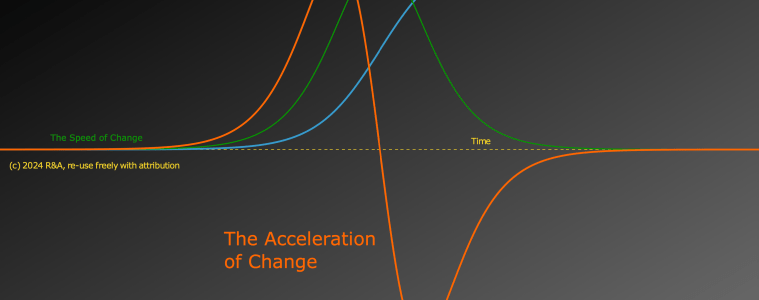
Fundamental properties of digital IT have set ons on a road not to a Singularity Point, but towards Complexity Crunch. That has consequences for our strategic (IT) choices and landscapes. A ‘long read’ (sorry) about lessons we can learn by now after half a century of Digital Revolution so far. Written as I have been giving talks about the subject this pas half year.
Don’t forget all the things that a core team performs to a tee, but that you never see

The third 'fragmentation wave' of the IT-revolution is upon us, it seems. Fragmentation/encapsulation is a repeated pattern in the IT-revolution for managing complexity. First as object oriented programming (for code) and later as agile (for IT landscape change). Now, it is the organisation’s turn to fragment. How strong is your mission, your ‘why’? You might soon find out, thanks to IT.
Definition of Ready, Done? What about a ‘Definition of Broken’?

As the IT world has been largely taken over by Agile methods, the concepts of Definition of Ready and Definition of Done have become mainstream. While these concepts were introduced at the story/sprint level in Scrum, they have taken on a wide role and are generally used at all levels these days, not just on stories, but also on features and epics, the larger items in the agile-tree. There is, however, a new concept that maybe very helpful at the higher levels that we might use: a Definition of Broken.
The lack of use cases for blockchain should teach organisations a valuable lesson about handling hypes

If someone tries to get you to invest in some shiny new technology — like blockchain 5-8 years ago — beware. How do you judge these proposals? A realistic use case is key.
Will McKinsey be the first ‘big consultancy’ that gets (enterprise) architecture right?
McKinsey seems to be the first 'big consultancy' that really frees itself from outdated, ineffective, orthodox enterprise architecture notions.
Dev, Test, Production — “It’s Turtles All The Way Down”
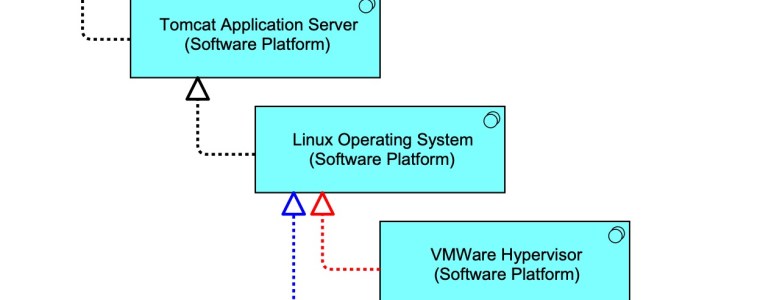
Most IT exists to support other IT, not your business directly. A part of this is that stack/web of platforms on which your applications depend. How does that for instance affect #informationsecurity in your designs?
From Dark Scrum to Broken SAFe — some real problems of Agile-at-scale. And a way out.

There is a massive movement of organisations moving to agile-at-scale (e.g. SAFe). Ironically, it can turn into an organisation becoming one big 'project', the opposite of what agile wants to achieve.
Don’t become an Enterprise/IT Architect…
With increasing IT volumes in the world, landscape change is getting harder and harder, and we need to adapt to that fact. Upper management is very slow to adapt and the Enterprise/IT Architect/Strategist's position becomes more frustrating as a result.
A tipping point in the information revolution
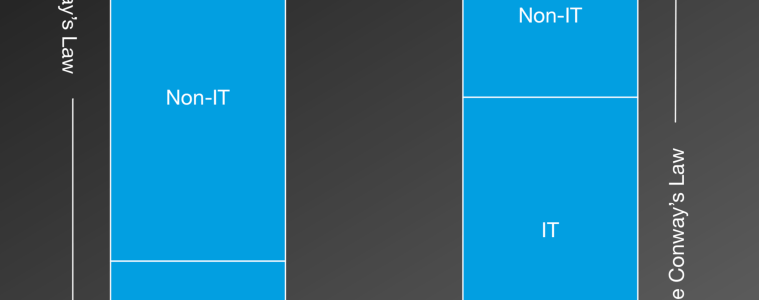
Because of the sheer volume of IT in the world, the behaviour of IT itself is becoming more and more an 'independent' factor, and we humans are adapting to it. Digital enterprise, digital transformation, Agile and DevOps are all illustrations of this tipping pont in the information revolution.
 R&A IT Strategy & Architecture