
Just copied from an earlier version on LinkedIn, a short article describing the key role of imagination in intelligence and why that may mean that self-driving cars require true intelligence and more than just reacting to sensors.
Category: Enterprise Architecture
AI-generated podcast AI-slopcast

We introduce a new term: "AI-slopcast". This is a podcast that is created by Generative AI and — surprise! — is AI-slop. The victim: one of my own posts.
AI has invented a new language, and added sex to a dull office context

It turns out that AI has created a whole new language. Humans do not speak it, and they may even mistake it for talk about sex. But luckily Generative AI is able to translate it to something humans can understand (and where the sex doesn't show up).
Generative AI ‘reasoning models’ don’t reason, even if it seems they do
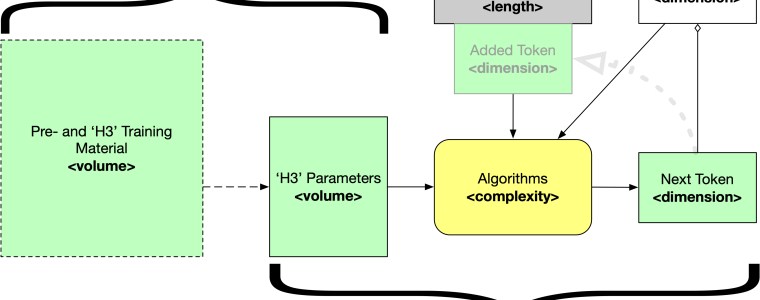
'Reasoning models' such as GPT4-o3 have become a well known member of the Generative AI family. But look inside and while they add a certain depth, at the same time they add nothing at all. Not 'reasoning' anyway. Just another 'level of indirection' when approximating. Sometimes powerful. Always costly.
Let’s call GPT and Friends: ‘Wide AI’ (and not ‘AGI’)
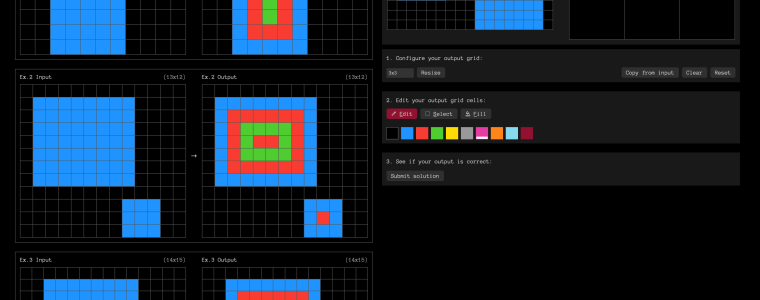
GPT-3o has done very well on the ARC-AGI-PUB benchmark. Sam Altman has also claimed OpenAI is confident that it can build Artificial General Intelligence (AGI). But that may be based on confusions around 'learning'. On the difference between narrow, general and (introducing) 'wide' AI.
Google’s ‘Willow’ quantum computer: impressive science and misleading marketing

Google has announced 'Willow', a quantum computer that can calculate so fast it would take a supercomputer 10 septillion (a 10 with 25 zeros) years to do the same. But while the science is real and cool, the message is misleading. An explainer for non-physicists.
Hello Human Intelligence, meet Complexity Crunch

[Sticky] Link to the YouTube video of the 'fundamentals' part of my 2024 talks on insights into the digital revolution. About how the IT revolution provides reliable performance, but the price paid is less agility (IT is brittle and thus ever more It becomes ever more difficult to change). About how we humans react/have reacted to this and why 'Complexity Crunch' and not a 'Singularity Point' is coming. Also contains links to related posts on the site for those that rather read than watch..
Can we break through the inertia that plagues IT-change?

You’re on the Titanic. The engineers are shouting: “The bulkheads are too low! The rudder is too small! There aren’t enough life boats!”. The sailors mumble: “It has been cold, there will be many more icebergs than usual and further south”. The owners are pressing the captain: “You should be in New York in six days, we desperately need a record!”. And the captain thinks: “I have execution power. I can break through. I will be successful.” and orders: “Northerly course and full steam ahead!”. Move fast and break things…
Like we don’t see air, we don’t see the Digital Revolution
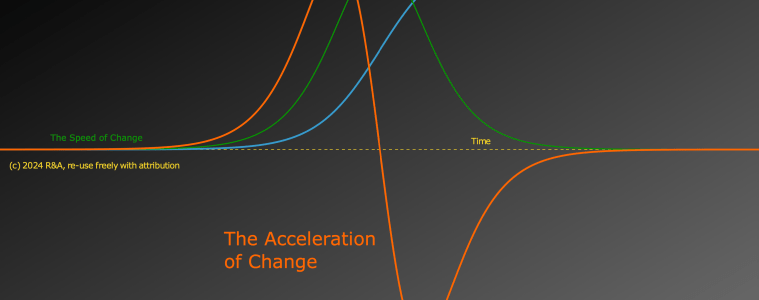
Fundamental properties of digital IT have set ons on a road not to a Singularity Point, but towards Complexity Crunch. That has consequences for our strategic (IT) choices and landscapes. A ‘long read’ (sorry) about lessons we can learn by now after half a century of Digital Revolution so far. Written as I have been giving talks about the subject this pas half year.
Generative AI doesn’t copy art, it ‘clones’ the artisans — cheaply

The early machines at the beginning of the Industrial Revolution produced 'cheap' (in both meanings) products and it was the introduction of that 'cheap' category that was actually disruptive. In the same way, where 'cheap' is acceptable (and no: that isn't coding), GenAI may disrupt today. But there is a difference. Early machines were separate inventions creating a comparable product. GenAI is trained on the output of humans, their skill is 'cloned' and it is this 'cloned skill' that produces the 'comparable product'. GenAI is not 'copying art', it is 'cloning the artisan'. And our intellectual rights haven't yet caught up.
 R&A IT Strategy & Architecture